

For measuring the engine's RPM, a pick-up mounted on the engine is used giving a frequency depending on the RPM. To be able to show the engine's RPM on an analogue tachometer, the frequency signal is sent through a fil converter {frequency/current converter), where the signal is transformed into a proportional 4-20 mA – 0-1200 RPM signal.
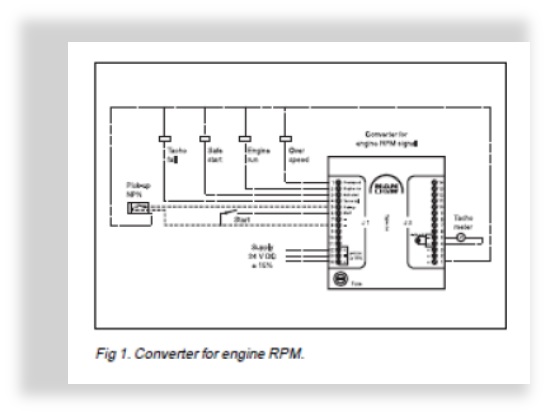
Further, the converter has following signals:
– overspeed
– engine run
– safe start
– tacho fail
Overspeed
When the engine speed reach the setpoint for electronic overspeed the converter gives a shutdown signal and an alarm signal through a relay.
Engine run
When the engine speed reach 710 RPM or 200 RPM + 10 seconds the converter gives a '''engine nut" signal.
The engine run signal will be deactivated when the speed is .640 RPM. If the engine speed haven't been over 710 RPM the signal will be deactivated at 200 RPM.
The "engine run" signals will be given through a relay. One for synchronizing and one forstartistop of pre. lub. oil pump or alarm blocking at start/stop.
Safe start
When the safe start signal is activated the engine can start. When the engine reach 140 RPM the air starter will be shut-off.
Further, the safe start signal is a blocking function for the air starter during rotation.
Tacho fail
The tacho fail signal will be on when everything is normal. If the pick-up or the converter fail s the signal will be deactivated. E.g. if there is power supply failure.
Turbocharger RPM signal
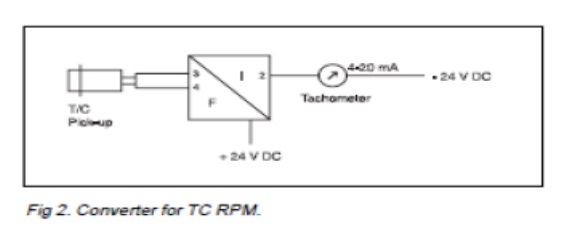
For measuring the turbocharger RPM, a pick-up mounted on the engine is used giving a frequency depending on the RPM. To be able to show the turbocharger's RPM on an analogue tachometer, the frequency signal is sent through a f/1 converter (frequency/current converter), where the signal is transferred into a proportional 4-20 mA0-60000
RPM.The converter for engine RPM signal is mounted in the terminal box on the engine.