Vessel break away from jetty

Vessel Break Away From Jetty Can Causes personal I

Vessel Break Away From Jetty Can Causes personal Injury, Significant Contact Damage To The Vessel Including Ranging And Grounding, Damage, Damage To Adjacent Vessels, Damage To The Environment. The Majority Of These Incidents Occured During Periods Of Adverse Weather, With High Winds Acting On Vessels With Large Windage Areas In Many Cases Additional Mooring Lines Were Deployed In Anticipation Of High Winds,ultimately To No Avail.
In Some Case The Vessel Moorings Were Even Supplemented By Shore Lines With Load Monitoring,however,the Vessel Still Broke Free Due To Excessive Loads On The Lines,seemingly As A Result Of Abnormal Tidal Flow Caused By Restricted Under Keel Clearance.in Another Case,the Vessel Did Get Tugs To Hold Her Alongside The Berth,only To Stand Them Down Prematurely. The Second Time The Vessel Came Off The Berth She Grounded Resulting In Substantial Bottom Damage.

What Are The Reasons Behind Such Incidents?
Whilst Incidents Of This Nature May Involve Reports Of Defective Mooring Equipment Or Lack Of Attention To Moorings, Investigations Suggest That In Many Incidents A Proper Risk Assessment Was Not Undertaken.it Is Recommended That Appropriate Risk Assessment Are Carried Out, Taking Into Consideration The Vessel’s Characteristics Type, Size, Trading Pattern And The Prevailing Weather Conditions. Factors To Be Taken Into Consideration Include, But Should Not Be Limited To, The Following:
Examples Of Wind, Tidal, Swell And Weather Related Factors
Wind Loads Exerted Onto A Vessel’s Superstructure And Hull Above The Water Line, Which Can Form A Large Proportion Of The Total Load On The Mooring System Depending On The Moored Vessel’s Location And Characteristics. Wave Loads On A Vessel, Which Can Vary Depending On The Vessel’s Response To Waves Of Varying Periods And Heights.of Special Concern Are Moorings In Relatively Shallow Water Depths, In Low Tide And High Wave Conditions.these Conditions Can Lead To Violent Vessel Behaviour At The Moorings (breaking Waves, Excessive Motions, Snatch Loads Etc.)And In Extreme Cases, Loss Of Under-keel Clearanse In Wave Troughs For Larger, Deeper Draft Vessels.Forces Resulting From Steady Currents In Combination With Other Loadings,especially At Low Water Levels In Breaking Wave Conditions, Which Can Also Exert Substantial Loads On A Ship’s Mooring System. The Effect Of Wind Against Tide Or Current And The Effect Of A Change In Tide Direction On Moorings. Tidal Surges Before, During And After Storms, Which May Be Well Away From The Area In Which The Vessel Is Berthed,causing Unusually Large Tidal Ranges And Lower Than Expected Water Levels. Examples Of Port/berth Related Factors – Characteristics And History Of The Port And Berth Any Unusual Occurrences.
– Peculiar Features Of The Berth Such As Overhanging Arrangements, Obstruction By Gantry Cranes, Wind Funnelling Effects From Shore Structures.
– Design / Type, Position, Quality And Adequacy Of Shore Mooring Equipment Including Storm Moorings And Fenders And Of Tugs.
– Exposure At The Berth To Wind,tide And Swell Conditions.
– Delay In The Availability Of Shore Mooring, Equipment, Mooring Gangs, Pilots And Tugs Etc.in Normal As Well As Emergency Situations.
– Proximity Of Other Vessels And Hazards In The Vicinity Of The Berth.
– Effect Of Passing Vessels On Vessels Moored Alongside.
– Availability Of Storm Bollards, Which May Not Be Useable During Cargo Operations If Moorings Restrict Working On The Berth.
.- Port/terminal Procedures In The Event Of Extreme Conditions And Their Suitability.
Examples Of Vessel Related Factors – Size/type Of Vessel, Notably The Windage Area (including Windage Area Due To Cargo Or Containers If Applicable) And The Related Effects Of The Same With Chandes In Wind, Tidal And Swell Conditions.
– Design/type And Condition Of Mooring Equipment, Its Limitations And Weaknesses
– Suitability Of The Mooring Pattern-number Of Lines, Lengths, Angles And Leads And The Ability To Maintain Even Tension On The Lines.
– Manning Level/crew Availability For Normal As Well As Adverse Weather Conditions.
– Weather Forecast And Warnings-reliability And Frequency. – Readiness Of Engines, Anchors And Power On Deck.
– Availability, Condition And Readiness Of Additional Moorings.

Whay Should We Do To Avoid Such Incidents?
It Is Recommend That The Master Carries Out A Proper Risk Assessment For The Different Mooring Conditions And Loadings To Suit Their Specific Vessel Characteristics And Mooring Location In Normal As Well As Adverse Weather Conditions. The Master Is Encouraged To Be Proactive In Requesting Information From The Port, Pilots And Agents And In Establishing How Warnings Will Be Broadcast By The Port However, He Should Not Rely Wholly On Information From Other Parties.in The Event That Deteriorating Conditions Are Forecast, The Master Should Make Timely Decisions To Ensure That The Vessel Is Brought To A State Of Immediate Readiness.amongst Other Things The Master Will Want To Esure That,before Conditions Become Extreme, The Vessel Is Fully Manned,is Appropriately Ballasted For Heavy Weather(with Due Regard To Under Keel Clearance At The Berth And In The Port),has Engines Ready, And Is In Close Contact With The Terminal And Port Authorities In Relation To Timing And Availability For Stoppage Of Cargo Operations,deployment Of Additional (storm) Moorings, And For Tugs, Pilots Etc. Most Importantly,the Master Will Need To Decide Whether To Ramain Alongside Or Depart From The Berth To Sea Or A Safe Anchorage.it Is Worth Bearing In Mind That Additional Precautions Such As Extra Mooring Lines May Not Prevent A Ship From Breaking Free From Her Moorings.
Last, But By No Means Least, It Is Also Worth Remembering That Mooring Stations Can Be Very Dangerous Plsces In Bad Conditions, Hence Another Good Reason Not To Delay Departure From The Berth Until It Is Dangerously Late The Terminal

Ballast Water Management

Ballast water Is Pumped In To Maintain Safe Operat

Ballast water Is Pumped In To Maintain Safe Operating Conditions Throughout A Voyage. This Practice Reduces Stress On The Hull, Provides Transverse Stability, Improves Propulsion And Manoeuvrability, And Compensates For Weight Changes In Various Cargo Load Levels And Due To Fuel And Water Consumption.​

How Ballast Water Management Came In Focous?
Ballast Water Taken Onboard By Ships Contain Thousands Of Aquatic Or Marine Microbes, Plants And Animals,small Invertebrates, Eggs, Cysts And Larvae Of Various Species,, Which Are Then Carried Across The Globe. Untreated Ballast Water Released At The Ship’s Destination Could Potentially Introduce A New Invasive Marine Species. Hundreds Of Such Invasions Have Already Taken Place, Sometimes With Devastating Consequences For The Local Ecosystem.Countries Like Canada And Australia Were Among Countries Experiencing Particular Problems With Invasive Species, And They Brought Their Concerns To The Attention Of IMO's Marine Environment Protection Committee (MEPC).
Image Text
Why BWM Is Important?
The Spread Of Invasive Species Is Now Recognized As One Of The Greatest Threats To The Ecological And The Economic Well Being Of The Planet. These Species Are Causing Enormous Damage To Biodiversity And The Valuable Natural Riches Of The Earth Upon Which We Depend. Direct And Indirect Health Effects Are Becoming Increasingly Serious And The Damage To The Environment.

What Is Required On The Ship By This Convention?
The Ballast Water Management Convention Will Require All Ships In International Trade To Manage Their Ballast Water And Sediments To Certain Standards, According To A Ship-specific Ballast Water Management Plan. All Ships Will Also Have To Carry A Ballast Water Record Book And An International Ballast Water Management Certificate. The Ballast Water Performance Standard Will Be Phased In Over A Period Of Time. Most Ships Will Need To Install An On-board System To Treat Ballast Water And Eliminate Unwanted Organisms. 
  
When International Convention For BWM Will Come In Fore?
The International Convention For The Control And Management Of Ships' Ballast Water And Sediments (BWM Convention) Will Enter Into Force On 8 September 2017
Under The Convention’s Terms, Ships Will Be Required To Manage Their Ballast Water To Remove, Render Harmless, Or Avoid The Uptake Or Discharge Of Aquatic Organisms And Pathogens Within Ballast Water And Sediments.

Voyage Data Recorder

The Purpose Of The Voyage Data Recorder (VDR) Equi

The Purpose Of The Voyage Data Recorder (VDR) Equipment Is To Store And Maintain, In A Secure And Retrievable Form, The Full Necessary Information That Has To Be Recorded Following An Incident, Thus, Proper And Correct Use Of VDR Is Considered Of Paramount Importance.

What Are The IMO Requirements Regarding VDR?
Passenger Ships And Ships Other Than Passenger Ships Of 3000 Gross Tonnage And Upwards Constructed On Or After 1 July 2002 Must Carry Voyage Data Recorders (VDRs) To Assist In Accident Investigations, Under Regulations Adopted In 2000, Which Entered Into Force On 1 July 2002.The Mandatory Regulations Are Contained In Chapter V On Safety Of Navigation Of The International Convention For The Safety Of Life At Sea, 1974 (SOLAS).
             Like The Black Boxes Carried On Aircraft, VDRs Enable Accident Investigators To Review Procedures And Instructions In The Moments Before An Incident And Help To Identify The Cause Of Any Accident.

What Does SOLAS Regulation Say?
Under Regulation 20 Of SOLAS Chapter V On Voyage Data Recorders (VDR), The Following Ships Are Required To Carry VDRs:
1. Passenger Ships Constructed On Or After 1 July 2002;
2. Ro-ro Passenger Ships Constructed Before 1 July 2002 Not Later Than The First Survey On Or After 1 July 2002;
3. Passenger Ships Other Than Ro-ro Passenger Ships Constructed Before 1 July 2002 Not Later Than 1 January 2004; And
4. Ships, Other Than Passenger Ships, Of 3,000 Gross Tonnage And Upwards Constructed On Or After 1 July 2002.

VDRs Are Required To Meet Performance Standards "not Inferior To Those Adopted By The Organization".
Performance Standards For VDRs Were Adopted In 1997 And Give Details On Data To Be Recorded And VDR Specifications. They State That The VDR Should Continuously Maintain Sequential Records Of Preselected Data Items Relating To Status And Output Of The Ship's Equipment And Command And Control Of The Ship. The VDR Should Be Installed In A Protective Capsule That Is Brightly Coloured And Fitted With An Appropriate Device To Aid Location. It Should Be Entirely Automatic In Normal Operation.
      Administrations May Exempt Ships, Other Than Ro-ro Passenger Ships, Constructed Before 1 July 2002, From Being Fitted With A VDR Where It Can Be Demonstrated That Interfacing A VDR With The Existing Equipment On The Ship Is Unreasonable And Impracticable.
Regulation18 Of SOLAS Chapter V On Approval, Surveys And Performance Standards Of Navigational Systems And Equipment And Voyage Data Recorder States That:
The Voyage Data Recorder (VDR) System, Including All Sensors, Shall Be Subjected To An Annual Performance Test. The Test Shall Be Conducted By An Approved Testing Or Servicing Facility To Verify The Accuracy, Duration And Recoverability Of The Recorded Data. In Addition, Tests And Inspections Shall Be Conducted To Determine The Serviceability Of All Protective Enclosures And Devices Fitted To Aid Location. A Copy Of A The Certificate Of Compliance Issued By The Testing Facility, Stating The Date Of Compliance And The Applicable Performance Standards, Shall Be Retained On Board The Ship.

What Are Simplified VDR (S-VDR) And Amendments Concerned?
The MSC At Its 79th Session In December 2004 Adopted Amendments To Regulation 20 Of SOLAS Chapter V (Safety Of Navigation) On A Phased-in Carriage Requirement For A Shipborne Simplified Voyage Data Recorder (S-VDR). The Amendment Entered Into Force On 1 July 2006.
         The Regulation Requires A VDR, Which May Be An S-VDR, To Be Fitted On Existing Cargo Ships Of 3,000 Gross Tonnage And Upwards, Phasing In The Requirement For Cargo Ships Of 20,000 Gross Tonnage And Upwards First, To Be Followed By Cargo Ships Of 3,000 Gross Tonnage And Upwards.
The S-VDR Is Not Required To Store The Same Level Of Detailed Data As A Standard VDR, But Nonetheless Should Maintain A Store, In A Secure And Retrievable Form, Of Information Concerning The Position, Movement, Physical Status, Command And Control Of A Vessel Over The Period Leading Up To And Following An Incident.

The Phase-in Is As Follows:
To Assist In Casualty Investigations, Cargo Ships, When Engaged On International Voyages, Shall Be Fitted With A VDR Which May Be A Simplified Voyage Data Recorder (S VDR) As Follows:
In The Case Of Cargo Ships Of 20,000 Gross Tonnage And Upwards Constructed Before 1 July 2002, At The First Scheduled Dry-docking After 1 July 2006 But Not Later Than 1 July 2009;
In The Case Of Cargo Ships Of 3,000 Gross Tonnage And Upwards But Less Than 20,000 Gross Tonnage Constructed Before 1 July 2002, At The First Scheduled Dry-docking After 1 July 2007 But Not Later Than 1 July 2010; And
Administrations May Exempt Cargo Ships From The Application Of The Requirements When Such Ships Will Be Taken Permanently Out Of Service Within Two Years After The Implementation Date Specified Above.

ME Lubricating Oil System

Q. What Are The Functions Of Main Engine Lubricati

Q. What Are The Functions Of Main Engine Lubricating Oil System?
Ans: Lubricating Oil Is Used For Lubrication Of The Running Gear Consisting Of Crank Shaft Bearings, Bottom End Bearings, Top End Bearings, Thrust Bearing, Cross Head Guides, Chains, Cams, And Gears Within The Crankcase. In Modern Engines, Oil Supply To Crosshead Bearing Is Arranged With Pressure Boosing Device To Achieve Higher Pressure To Force The Oil Between The Bearing And The Cross Head Pin At Peak Loads.
Basic Functions Of Lubricating Oil Are: Reducing Friction Between Moving Parts In Contact, Cooling, Cleaning, And Protecting Components Against Corrosion.

Q. Explain The Diesel Engine Lub. Oil System? 
Ans: Line Diagram For Diesel Engine Lub Oil System Image Text
Here In The Diagram Above, We Can See
i) Sump Tank: Sump Tank Is A Lub Oil Collection Tank At The Bottom Of The Diesel Engine, Where The System Oil Returns And Get Collected After Lubricating The Parts. Again, This System Oil Is Transferred Back Into The System By Pumps.  

ii) Centrifugal Separator: Its Also Known As Auto Backwash Filter, It Takes Up The Lub Oil From Sump And Passes It Through A Revolving Filter Mesh.Thus, Cleaning The Oil For Reuse. 

iii) Strainer: It’s A Filter Which Separates Bigger And Heavier Objects And Does Not Allow Them To Move Into The Pump, Thereby Helping Them Not To Clog The Sytem. These Objects Like Cloth Or Spanner Might Be Lying Into The Sump, Which May Have Fallen During Inspection.

iv) Pumps: These Are Two In Number, One In Use And Other Standby. If They Are Submerged In The Sump, They Will Be Centrifugal Pumps Otherwise They Will Be Screw Pumps. Centrifugals Are Submerged Into The Sump Because It Helps To Maintain Constant Suction And Theier Is No Fear Of Loosing Suction. Generally, The Pressure Is Maintained At 4-4.5 Bar In MAN B&W Engines.

v) Fine Filter: It Separates The Small Particles Such As Metal Particles To Enter Into The System. 

vi) Cooler: Generally Plate Type Heat Exchangers Are Used For The Purpose. They Have Better Cooling Efficiency Than Tube Type Coolers. Lub Oil Is Cooled Upto 40-45 Deg C. Reason For Cooling Is That Oil Gets Heated Up Due To Contact With With Heating Parts, While Cooling Them.

Q. What Are The Functions Of M/E Cylinder Lubrication System?Image Text
Ans:  Cylinder Oil Reduces Frictional Resistance Between Piston Rings And Liners, Neutralises Acidic Conditions Created By The Products Of Combustions, And Act As An Insulting Film Between Cylinder Wall And Hot Gases. Here Is A Line Diagram For Cylinder Lub Oil System. From The Diagram Its Clear How The System Is Functioning.

Q. What Is The Function Of A Cam Shaft?
Ans: Function Of The Camshaft Is To Operate Fuel Pumps, Exhaust Valves, And It May Operate Pilot Air Valves For Starting The Engine. On Some Engines, In Some Engines To Prevent Contamination Of Crankcase Oil With Fuel Leaking Past Fuel Pumps, Camshaft Lubrication System Is Independent Of Crankcase Lubrication.

Q. How Does Gear & Turbocharger Lubrication Take Place?
Ans:  Gear Lubrication : On Ships With Gears For Propeller Drive, Shaft Generators, Turbo-generators, Etc., A Separate Lubricating Oil System Is Provided.Gear Drive Within The Crankcase Of An Engine Is Lubricated Through The System For Lubrication Of Bearings And Cross-head Guides.
 Turbo-charger Bearing Lubrication
Lubrication Of Turbocharger Bearings Is By Means Of Self Driven Pumps And Oil Sumps At Each End Of The Rotor Shaft. On Some Ships, Turbo-charger Bearings Get Supply From The Crankcase Lubricating Oil System Through An Overhead Tank. 

Pipeline Tracing

Points You Should Be Aware About “Pipeline Tracin

Points You Should Be Aware About  “Pipeline Tracing” :
Tracing Pipelines Means That You Would Physically See The Pipeline From Point To Point And Recognize Various Fittings (valves, Pumps, Interconnections, Etc.) In A Particular System. This May Involve Going Up And Down Various Levels In The Engine Room, Going Under And Behind Equipment  and Machinery, And Going Under The Floor Plate. Tracing A Pipeline Can Be Very Revealing And Satisfying. It Will Build Your Confidence And Minimise Chances Of Mistakes. Irrespective Of An Access To Pipeline Diagrams Or Mimic Diagrams, You Should Trace Pipelines Of All The Essential Systems In The Engine Room. 
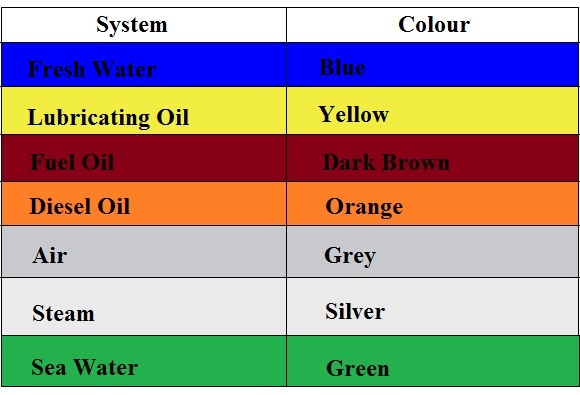
Your Task Of Tracing Pipelines Will Be Very Easy If Pipelines Of Each System Have Been Marked Or Painted According To A Colour Code.
An Example Of A Colour Code Is Given Here, It Might Be Different On Some ShipsImage Text  .
 
Tracing Pipelines
With Proper Planning You Will Be Able To Trace Pipelines Accurately And With Less Effort. You Will Need A Torch And A Notebook To Make A Rough Diagram As You Proceed From Place To Place.Following Approach Is Recommended.  
1. Make A List Of Pipelines You Need To Trace.
2. Prioritise Your Approach To Learning (call It A, B, C, D, Etc.)
3. Take Permission From Your Superior / Watch Keeping In-charge Before Starting To Trace A Pipeline.
4. Tracing Of Pipelines Will Be Done Under  'manned Engine Room' Situation.

Precautions:
1. Inform Watch Keeping Officer About Your Intentions And Where Abouts.
2.  Be Careful While Looking Up And Moving At The Same Time.
3. Keep Safe Distance From Moving Machinery.
4. Do Not Open Or Close Any Valve Or Tamper With Any Setting On The Equipment.
5. If You Remove Any Floor Plate Look Underneath, Place A Warning Signs To Draw Attention Of Others Who May Walk There.
6. Replace Floor Plates And Any Cover Plates For Valves. 
7. If You Are Using A Hand Lamp, Check Its Wires And Ensure That Safety Cage Is Well Secured And The Glass Is Intact.


Shipping Manager Shot Dead In Paradeep

The General Manager Of Hyderabad-based Seaways Shi

The General Manager Of Hyderabad-based Seaways Shipping And Logistics Ltd (SSLL) Was Shot Dead In A Suspected Case Of Business Rivalry In The Port Town Of Paradip On Wednesday. According To Police Sources, Swain Was In His Scorpio With His PSO And Driver To Office When The Miscreants On Some Unidentified Motorcycles Hurled Two Bombs At His Vehicle At The Madhuban Mausi Ma Temple Square. The Bombing Had Damaged The Front Glass And Left Door Of The Scorpio. While Swain Fled To The Nearby Bachelor Quarters, The Miscreants Fired Two Rounds Of Bullets Of Which One Hit His Head And Another Pierced His Chest. He Was Immediately Shifted To Atharabanki Biju Memorial Hospital And Later To SCB Medical, Cuttack, Where He Was Brought Dead, Doctors Said.

Paradip Additional SP Gadadhar Padhani And IIC Subhranhsu Shekhar Nayak Reached The Spot With A Team To Initiate Investigation. A Scientific Team Has Also Reached The Spot To Support Police In The Investigation. Paradip SP J N Pankaj Has Also Reached The District Police Headquarters For Inspection Into The Matter.
"Preliminary Investigations Pointed To The Possibility Of Past Enmity And Business Rivalry Behind The Murder. We Have Formed A Special Squad To Nab The Killers. We Have Sealed All Entry And Exist Points In The Port Town," Additional Superintendent Of Police (ASP), Paradip, Gadadhar Pradhani Said.Image Text

Ranjan Swain, The Nephew Of Mahendra, Alleged That A Paradip-based Stevedore Company Was Behind The Murder. It Must Be Mentioned That Local Stevedore Companies Engaged In Paradip Were Unhappy When The Steel Authority Of India Ltd (SAIL), M/s. Jindal Steel & Power Ltd. (JSPL) And Others Employed Seaways Shipping And Logistics Ltd For Handling Their Cargo Last Year. SSLL Had Won The Cargo Handling Rights In A Global Tender. But Rival Stevedore Companies Were Opposed To The Firm Being Awarded The Contract.

Last Year, Around 37 Stevedores Companies Under The Banner Of Paradip Port Stevedores Association (PPSA) Had Opposed The Decision Of Paradip Port Trust (PPT) To Allow SSLL Access To The Port. The PPSA Had Also Stalled Work For A Week On The Issue.

Courtesy: Pragativadi,MSN

Cylinder Lubrication : Purpose, Properties and On-board tests

Q. Why Cylinder Lubrication Is Required?

Q. Why Cylinder Lubrication Is Required?
Ans:  Cylinder Lubrication Is Required To Develop An Oil Film Between Piston Rings And Cylinder Liner To Avoid Metal To Metal Contact. In Latest Engines, With Higher Peak Pressure And Cycle Temperature Good Quality Of Cylinder Oil Is Required To Maintain An Oil Film Between The Rings And The Liner For A Long Period Of Time. Apart From Lubrication Its Other Properties Enhance Engine Performance.

Q. State, With Reasons, Five Desirable Properties Of Cylinder Oil Used For An Engine Which Is Burning Residual Fuel.
Ans: Five Desirable Properties Of Cylinder Oil Used For An  engine Which Is Burning Residual Fuel Are;
It Must Effectively Neutralise The Corrosive Effect Of Suphuric Acids Formed During Combustion Of Fuel.
It Must Prevent The Build Up Of Deposits In The Ring Grooves And In Ports Of Port Exhausted Two Stroke Engines.
It Must Be Able To Burn Cleanly, Therefore Leaving As Little As Possible Soft Deposits.
It Must Pocess Adequate Viscosity At High Working Temperatures.
It Must Form An Effective Seal In Conjunction With Piston Rings To Prevent Blow By.

Q. How An Effective Film Can Be Obtained Over The Entire Liner Surface?Image Text
Ans: An Effective Oil Film Can Be Obtained Over The Entire Surface Of The Liner By Means Of Cylinder Lubrication.
Oil Is Injected Through A Number Of Holes Drilled In The Liner, Usually Six Or Eight Of These Displaced Circumferentially Around The Liner At A Chosen Vertical Position Within The Piston Stroke. Oil Is Supplied By Pressure Pulses From Positive Displacement Mechanical Lubricators Driven From The Engine Camshaft And Regulated To Deliver Oil At A Given Rate.
Lubricator Quills Are Connected To Each Oil Hole And Contain A Non-return Valve To Prevent Blowback. To Assist In Distribution Of Oil Around The Liner Circumference, Oil Gutters Adjacent To Lubricator Points Angled Downwards To Assist Flow By Gravity Are Fitted. Lubricating Oil Is Spread Over The Length Of The Liner By The Piston Rings During Their Stroke. 

Q. How It Can Be Ensured That The Correct Quantity And Quality Of Cylinder Lubricating Oil Is Being Used?
Ans
: It Can Be Assured That The Right Quantity And Quality Of Cylinder Lubricating Oil Is Used By;
The Quantity Is Controlled By Linking The Pump Drive To The Engine Throttle Setting Levers, The Oil Quantity Then Being Regulated To The Power Produced. To Ensure The Quality Of The Oil Used Is Maintained For Lubrication And Not Burnt By Hot Gases, An Accumulator Can Be Fitted To The Cylinder Lubricator Quills So That A Quantity Of Oil Will Enter Each Time The Cylinder Pressure Drops Below That In The Accumulator, Thus Ensuring Oil Does Not Enter The Cylinder When Exposed To Hot Gases.

Q. How A Representative Sample Of Lubricating Oil Is Obtained From The Main Engine System For Analysis?
Ans:
 To Obtain A Representative Sample Of Lubricating Oil From The Main Engine System; A Clean Sample Bottle Must Be Used, The Sample Must Be Taken From An Area On The System Where There Is A Good Flow, Not From Filters Or The Sump.
The Best Place For The Sample To Be Taken, Would Be From The Lubricating Oil Rail / Supply Line, Ideally The Sample Point Should Be A Dedicated Sample Point To Avoid Accidents. 

Q. Describe Three On Board Tests For Lubricating Oil?
Ans:

The Flow Stick Test: This Is Where The Viscosity Of The Lubricating Oil Is Tested. Two Samples Of Oil Are Used For This Test, One From The System, And The Other, Fresh New Oil. The Flow Stick Contains Two Reservoirs, One For The System Sample And One For The New Fresh Oil, These Reservoirs Are Filled And The Samples Are Allowed To Reach The Same Temperature.The Flow Stick Is Then Tilted From The Horizontal And The Oil Flows Down Two Parallel Chanels, When The Fresh Oil Reaches A Reference Point, The Flow Stick Is Returned To The Horizontal.The Distance Traveled By The Used System Oil Is Compared To That Of The New, Fresh Oil And If The Used Oil Is Between The Two Used Oil Comparison Points, The Used System Oil Is Still In Good Condition.

Water In Oil Test: The % Water In Oil Test Is Used To Give An Indication If Any Of Water In The Lubricating Oil, Here A Fixed Amount Of Oil Is Sampled From The System, Which Is 5ml And Placed In A Capsule Where There Is A 15ml Solution Of White And Reagent. A Lid Incorporating A Pressure Gauge That Is Calibrated To Read % Water In Oil Is Then Screwed Onto The Capsule To Form An Air Tight Seal. The Capsule Is Then Shaken Vigorously For 1 Minute, Then Left To Stand, Any Water In The Lubricating Oil Will React With The White Spirit And Reagent Causing A Rise In Pressure That Will Be Read On The Pressure Gauge As % Water In The Lubricating Oil

Microbiological Degradation Of Oil Test:  This Test Will Give An Indication Of An Infestation Of Microbiological Organisms In The Lubricating Oil. The Test Makes Use Of Slides That Are Coated With A Special Gel, Which Is Dipped In The Sample Of Lubricating Oil, The Slide Is Then Placed In A Test Tube, Sealed And Left To Incubate, Any Growth That Comes About In The Incubation Period Is Then Compared To A Chart To Indicate Any Infestation By Microbiological Organisms.

Q. If No Testing Equipment Was Available, Explain How The Condition Of Lubricating Oil Could Be Assessed On Board?
Ans:
 If No Test Equipment Is Available On Board, Lubricating Oil Condition Can Be Determined By A Few Simple Tests:
Crackle Test For Water, This Is Where A Sample Of  lubricating Oil Is Take And Placed In A Test Tube, The Test Tube Is Then Heated, Any Water Droplets Will Make A Crackling Noise Due To The Formation Of Bubbles, This Will Only Detect Small Amounts Of Water, For Larger Amounts, A Simple Settling Test Can Be Used.

TBN Can Be Tested By Placing A Drop Of Indicator Solution On To Blotting Paper, This Being Followed By A Drop Sampled Lubricating Oil In The Centre Of The Blotting Paper. A Colour Change Should Take Place Around The Surrounding Area Of The Drop I.e. If The Colour Is Red, This Shows Acid Is Present, Green / Blue Show S Alkaline Presense.
Note: Filters Will Also Give A Good Indication Of The Lubricating Oil Quality.

240 migrants drowned off Libyan coast on Wednesday

At least 240 migrants have drowned off the coast o

At Least 240 Migrants Have Drowned Off The Coast Of Libya Within The Last 48 Hours, Possibly As An Unintended Consequence Of European Efforts To Stop People-smugglers And To Train Libyan Coastguards, The U.N.'s Migration Agency Said. Five Rescue Ships, Coordinated By The Italian Coastguard, Were Within Sight Of The Migrants But, Despite Attempts To Rescue Them, Most Died.

A Total 31 Survivors Of Two Shipwrecks Who Arrived On The Southern Italian Island Of Lampedusa Reported That The Rubber Dinghies They Were Traveling In Had Capsized On Wednesday In Heavy Seas Shortly After Leaving Libya.
The First Dinghy – Which Carried Around 140 People, Including Six Children And About 20 Women, Some Pregnant – Sank When Wooden Planks Laid At The Bottom Broke, Causing The Dinghy To Capsize 40km Off The Libyan Coast, The UNHCR Said. Twenty-nine People Were Rescued And 12 Bodies Were Recovered.Image Text

In A Separate Operation, Two Women Found Swimming At Sea Told Rescuers That 128 Other People Had Died In Their Wreck.
In Both Cases, Most Of The People On Board Appeared To Have Been From Sub-Sahara Africa, But Sami Said Aid Workers Were Still Ascertaining Details.Sources Said That The Latest Wrecks Meant That 4,220 Lives Had Now Been Lost In The Mediterranean So Far This Year – The Highest Toll On Record.

Migrant Arrivals In Italy Surged To 27,388 In October, More Than The Two Previous Octobers Combined, And Bringing This Year's Total To More Than 158,000, IOM Spokesman Told .Refugees Have Told The IOM That People Smugglers Say European Training Of Libyan Coastguards Means That Rescue Missions May Soon Be Handed Over To Libya, And That Any Rescued Migrants Will Be Taken Ashore In The Northern African Country Rather Than In Italy.

According To Doyle, The Use Of Dinghies, Especially Unsuitable For The Long Sea Crossing In Bad Weather, Was Partly Due To European Navies Capturing And Destroying Many Of The Fishing Boats That Smugglers Had Been Using.
"In The Absence Of Those Boats And With The Migrants Determined To Leave, And The Smugglers Interested In Making Money Off Them, They Have Been Putting Them In Completely Unsafe Rubber Dinghies," He Said.

Survivors From One Dinghy, Whose Passengers Included About 20 Women And Six Children, All Believed To Be From West Africa, Said They Set Off From Libya At About 3 A.m. (0500 GMT) On Wednesday, But The Boat Sank After A Few Hours. Twelve Bodies Were Recovered, Including Three Babies, And About 27 Survived.

Separately, Italy's Coastguard Said Rescuers Pulled About 766 People To Safety From Boats In Difficulty In The Central Mediterranean On Thursday, And Found The Dead Body Of One Woman. Another Two Women Said They Had Survived The Sinking Of A Second Dinghy At About The Same Time. Theirs Was Carrying About 130 People, They Said.The IOM Said The Latest Deaths Meant 4,220 Migrants Had Died In The Mediterranean So Far This Year, Compared With 3,777 In The Whole Of 2015. 

Courtesy: MSN, India Times

FAQ MEO Orals : Compressor

Q. What is volumetric efficiency of air compressor

Q. What is volumetric efficiency of air compressors?
Ans: Actual volume of air drawn in / swept volume.

Q. What is compression ratio?
Ans:
(Swept volume + clearance volume)/clearance volume

Q. What is free air delivery?
Ans:
Volume of delivered air measured at 1 atmospheric pressure and 15*C is called free air delivery.

Q. What is bumping clearance? How do you measure it?
Ans
: Clearance volume or bumping clearance is the space between the top of the piston and the cylinder head of an air compressor. This clearance is an important aspect of the compressors and should be as less as practically possible to improve the volumetric efficiency of the compressor. The clearance volume should not be too less or too more. Moreover, it affects the efficiency of the machinery and thus should be checked at regular intervals of time.
Significance and Effects of Bumping Clearance
In an air compressor, when the discharge valve closes in the end of the compression cycle, a small amount of high pressure air is trapped in the clearance volume.
Before again taking suction, the air trapped in the clearance volume must expand below the suction pressure i.e. below the atmospheric pressure.
The expansion of this trapped air in the clearance volume causes effective loss of stroke due to which the volumetric efficiency of compressor drops. Therefore, the clearance volume has a significant effect on the efficiency of the compressor.

Effects Due to Less Clearance
Small clearance volume may result in piston banging or colliding to the cylinder head.
This is dangerous when the compressor when is running in unloaded condition without any resistance to the movement of the piston.

Effects Due to Large Clearance
Large bumping clearance retards the formation of vacuum on the suction stroke and thus less air is drawn inside for compression and accordingly the weight of the air delivered is reduced proportional to the clearance volume. Compressor has to run for a longer period to provide the necessary compression pressure.

Reasons for Change in Clearance Volume
During overhauls of the air compressor, if the gasket fitted between the cylinder head joints is of the wrong type, then the bumping clearance will increase, resulting in wear down of bottom bearings or wrong bearings are put in place.
How Bumping Clearance is checked?
Bumping clearance is checked by putting a lead ball or plastic gauges over the piston and then turning the compressor one revolution by hand.
By doing this the lead ball will compress and the thickness obtained is the clearance volume.
This thickness is measured with Vernier caliper or micrometer and is then compared with the manufacturer’s value. Adjustments are made in case there is an offset in the value.

Adjustment of bumping clearance
Bumping clearance can be adjusted with the help of inserting shims (thin metallic plates) in the bottom bearings. Inserting shims will move the connecting rod and the piston which will change the clearance.
What should be the Bumping Clearance?
Generally bumping clearance depends on the manufacturer but as a thumb rule it should be between 0.5% to 1% of the bore of the cylinder.

Q. What are the reasons of HP stage relief v/v lifting?
Ans: 

a. Delivery v/v shut.
b. Setting error of pressure switch.
c. Delivery v/v which is SDNR type is fitted inverted.

Q. What are the reasons for LP stage relief v/v lifting?
Ans: 

a. HP stage suction v/v or discharge v/v leaking.
b. 2nd stage suction n discharge v/v interchanged after overhaul.

Q. How lubrication takes place in main bearing, crankpin bearing, upper & lower cylinder in case of tandem type air compressor?
Ans: 

a. For main brg & crankpin brg- pressure lubrication provided by shaft driven gear p/p.
b. For lower cyl. In tandem type- it’s by splash.
c. For upper cylinder in tandem type- there is a supply from drilled hole in con. Rod which is scraped down by scraper ring into the lube oil sump.

Q. What are the reasons for low L.O pressure in an air compressor?
Ans: 

a. Motor rotation direction reversed.
b. Oil line blocked due to rag/dirt.
c. No oil in sump.
d. Filter clogged.
e. Worn metal of the bearing=> more clearance=> low oil pressure.

Q. What are the reasons for increased lube oil consumption in an air compressor?
Ans: 

a. Excess oil in sump (above level H).
b. Oil scraper ring worn out.
c. Worn piston and liner. 

Q. What checks do you make if a compressor trips on low lube oil pressure?
Ans:
In case of reciprocating compressor
a. Direction of rotation, in case the motor is overhauled or some maintenance carried on the motor.
b. Suction filter should be cleaned.
c. Check the pressure switch.
d. Inspect the lube oil pump
e. Check if any lube oil pipe is holed
f. Check for excessive foaming

In case of rotary compressor,
a. Check whether the lube oil pump is rotating with the compressor
b. Check the condition of vanes and the elliptical casing for scoring damage
c. Check the compressor is free to turn, no seizure of rotor, no wear on the vanes and the casing.
   
Q. What is the purpose of breather in an air compressor?    
Ans:
Breather- it is provided so that pressure or vacuum is not created inside crankcase. It has filter to prevent moisture and dirt from going inside the crankcase and also has metallic plate on the inner side which doesn’t allow lube Oil to come out.

Q. Why intercooling is provided in an air compressor? And why is the compression distributed into stages?
Ans: 

a. By employing the inter stage cooling we are trying to achieve an isothermal compression cycle in order to minimize the work done in the process.
b. The air outlet temperature after compression is lowered by intercooling. So oxidation of the lube oil is prevented. Also good lubrication is achieved.
c. Lesser deposits in the air system.
d. Intercooling increases the air density and hence reduced volume of the HP compression chamber is possible.
e. It facilitates removal of moisture by condensation at the intercoolers.
f. To facilitate intercooling the compression is distributed into stages. Also even load distribution is achieved over the cycle.
 
What would be the consequences of too high valve lift in an air compressor?
Ans: 

a. Chances of damage due to impact.
b.Decrease in vol. efficiency.
 
Q. What would be the consequences of a high spring constant of spring plates in an air compressor?
Ans: 

a. Valve will open late.
b. It will close with higher impact which may cause damage.
c. It also reduces volumetric efficiency.
 
Q. Can we interchange spring of suction & delivery v/v?
Ans:
No.Delivery valve’s spring stiffness is more.

Q. What are the necessary checks before manual starting of an air compressor?
Ans: 

1.  Lubrication: check the oil level in the sump ( between H & L )and in the lubricator tank(if provided) .
2. Unloading: the valves in the unloading lines must be open.
3. Pressure gauge cocks: the cocks must be slightly open to avoid excessive pressure fluctuations which can damage the pressure gauges.
4. Air filter: check that the air intake filter is clean.
5. Cooling: check that the Cooling water pressure is correct (0.2-2bar) and in the case of attached pump a visual check of the pump to be carried out and all the valves in the line must be open.
6. Relief valves: some relief valves have hand testing levers given for testing, the same can be done.
7. Air-line piping: check that all the valves in the discharge piping are open and correctly lined up.
8. Final check: the compressor can be turned a few revolutions with a turning bar to check for the free movement.

Q. What if the compressor motor connections are reversed after overhauling?
Ans: 

a. The lube oil pressure will not be sufficient for lubrication so the compressor may trip on low lube oil pressure. The moving parts may get damaged due to the failure of the lubrication.
b. The cooling water pump which is also shaft driven usually does not build up enough flow/pressure hence the compressor may trip because of the cooling water non flow or high air temperature.

Q. What are the reasons of piston seizure in a reciprocating air compressor?
Ans: 

a. Insufficient lubrication.
b. Lack of cooling water.
c. Valve part broken and fallen into the chamber.
d. Piston ring broken.

Sewage Treatment Plant

Q. What do you mean by a Sewage treatment unit and

Q. What do you mean by a Sewage treatment unit and its use onboard?
Ans :
The Sewage Treatment unit is a self contained system for the treatment of sewage from ships or rigs before it is discharged overboard and so prevent the pollution of harbour and coastal waters and inland waterways_ The system uses the aerobic principle of sewage digestion, coupled with treatment of the final effluent, and is generally accepted as the most compact, efficient and flexible system for use on board ship.The unit operates satisfactorily on salt, fresh or brackish flushing water.

Q. Define the other parts of a Sewage treatment unit?
Ans :
Basically the Super Trident Sewage Treatment unit comprises a tank, divided into three water tight compartment. An aeration compartment, a setting compartment, and a chlorine contact compartment.
The incoming sewage enters the aeration compartment, where it is digested by aerobic bacteria and micro organisms which are promoted in the sewage itself by the addition of atmospheric oxygen.
From the aeration compartment the sewage flows into the settling compartment where the aerobic bacteria floc, known as activated sludge, is settled out producing a clear effluent which passes through a chlorinator and into the chlorine contact compartment before being finally discharged.

Q. Describe the purpose of its different compartments and fittings?
Ans :

Aeration Compartment
In this compartment of the treatment unit, aerobic bacteria, that is those bodies requiring dissolved oxygen  to  exist,  reduce  the  influent  waste  material  which mainly  comprises  Carbon,  Oxygen, Hydrogen, Nitrogen and Sulphur into Carbon Dioxide, Water and new bacteria cells.   The Carbon Dioxide is emitted throughout the vent system whilst the water together with the bacteria cells are displaced into the settling compartment.
Air is supplied to the sewage from a rotary compressor through a number of fine bubble diffusers, located at the bottom of the tank but removable from the side for ease of maintenance.
The air provides the life giving oxygen to the aerobic organisms and also keeps the contents of the tank intimately mixed with the incoming raw sewage and the returned settled activated sludge.

Settling Compartment
In the settling compartment the bacteria settle out and are returned to the aeration compartment by the airlift tube.   This takes its supply from the bottom of the compartment and discharges to the aeration compartment, via a visual indicator pipe which enables a check to be made on the sludge return.   The settling compartment of the unit is of the hopper type.   The sloping sides prevent the sludge from accumulating and direct it to the suction side of the air lift.   The effluent enters the compartment through a stilling chamber and rises through the clarifier, to discharge to the chlorine contact compartment through a weir at the top of the clarifier.  A surface skimmer is provided to skim off and return surface debris back to the aeration tank – a second airlift is used for this purpose.

Chlorine Contact Compartment
The effluent is stored in this compartment after chlorination to allow time for the chlorine to kill off any harmful bacteria. On units fitted with a discharge pump two level regulators (or float switches) are fitted to control the operation of the pump, see Electrical Controls.
An additional float switch is 'fitted which operates an alarm signal should the level rise above the normal 'high' position.
An emergency overflow pipe connection is also provided through which only treated effluent can pass.

The Chlorinator
Tablet disinfection (standard).   This is of the tow-through type and all of the effluent passes over the specially formulated tablets and absorbs the required amount of chlorine before flowing into the chlorine contact tank.
One or two tubes depending upon test results (see Section 4 – Determination of Residual Chlorine Content) are filled with tablets and placed in position in the chlorinator with the cut-away sections at the lower end.  The effluent flows around and past the lower end of the tube and comes into contact with the tablets.
At the outlet end of the chlorinator is a control weir arranged so that as the effluent flow increases the level rises and more tablets come into contact with the effluent  In this way the chlorine uptake is always sufficient for sterilisation of the effluent.

Discharge Pump
These pumps are horizontal close coupled centrifugal units with a 2-bladed open impeller of the non-clog type.  They are designed for capacities up to 4D m3/11 and operate at 2-pole motor speeds.
The medium head pump is suitable for heads up to 18 metres.   The high head pump is suitable for heads up to 25 metres.
The pumps are particularly suited for effluent discharge, sump drainage and  handling dirty water containing solids up to 25rnm. diameter.

Air Compressor
One rotary vane air compressor is fitted as standard.
The rotary air compressor motors, are operated by manual switches on the control panel.  When a discharge pump is supplied it is controlled by float switches fitted in the final effluent tank with an overriding HANDIAUTO switch on the control panel.

Float Switches
These are of the magnetic reed type with three 'floats mounted on a common stem and wired to the control panel.  The two lower floats operate the discharge pump{s}, and the upper float operates the high level alarm circuit should the level rise above normal.

Q. Explain its Operation?
Ans : When the system is fitted with a discharge pump and the control switch is in the AUTO position, the typical sequence of operation is as follows:
When the liquid reaches the "High' level float switch, the pump motor is started and the liquid begins to discharge from the compartment The pump continues to run until the liquid drops to the level of the "Low' level float switch when the motor is switched off
Should the 'High' level alarm float switch fail to operate for any reason, the level of the liquid will reach the 'High' level alarm float switch, and actuate the alarm circuit